Nita Kohli
Prefer a PDF? Download the full report →
Optimization creates efficiency. Differentiation creates value. Intentionality determines the future.
Every so often, a simple observation changes the way we see an entire industry, not because the observation itself is remarkable, but because once we notice it, we begin to observe the same pattern everywhere. That happens more and more frequently, and it led me to a much larger question.
The Age of Convergence
I wasn't looking for a new idea. Artificial intelligence wasn't even on my mind. Walking through a parking lot after a meeting, I noticed something I hadn't quite let myself see before: vehicles from different manufacturers had become remarkably difficult to distinguish. Same silhouettes, same color palettes, same grille proportions, same restrained, aerodynamically optimized lines. Sound familiar?
As I started thinking more about it, I couldn't stop noticing it everywhere. Homes in new developments follow the same handful of floor plans. Websites open with the same hero image and the same button in the same corner. Executive resumes list the same verbs: spearheaded, drove, achieved, optimized, describing accomplishments that, on paper, are indistinguishable from every other candidate's.
Best practices spreading and expectations rising is not new. What is new is the pace: AI does not just spread best practices, it generates them, applies them instantly, and redistributes them to everyone with access to the same models, which is increasingly everyone. A capability that once took a consultancy months to install can now be installed in an afternoon.
I use AI every day, and I believe executives should understand what it can do, and what it shouldn't do.
“As AI makes us more efficient, does it also make us more alike?”
This article is not an argument against artificial intelligence. It is an argument about leadership. Artificial intelligence simply makes visible a question leaders have always faced: when everyone has access to the same capabilities, what creates enduring advantage?
My proposition is straightforward. As optimization becomes increasingly abundant, differentiation becomes increasingly valuable. That changes not only how organizations compete, but how leaders allocate resources, define strategy, and create value.
The Value of Differentiation™
For more than thirty years, my work has focused on helping organizations reduce unnecessary variation, the version of a process that exists only because someone once did it that way, and no one has asked why since, nor challenged it. From a risk perspective, standardization is foundational: it reduces operational variability, improves controls, and strengthens resilience. But there is a distinction between reducing operational variation and eliminating strategic variation. The former reduces risk. The latter may eliminate competitive advantage.
Optimization raises the baseline. Differentiation creates enduring value above it.
None of this argues against optimization. Most of what an organization does is legitimately repetitive, and it should be optimized. The question was never whether to optimize. It is what to optimize, and what to hold apart. Strategy theory has drawn this distinction for decades, between operational effectiveness, doing what everyone does, only better, and strategy itself, doing something different. What has changed is the speed and scale at which AI now makes operational effectiveness available to everyone. That is exactly why deciding what stays different matters more than it used to, not less.
Differentiation gets confused with novelty more often than it should, being different isn't the same as being valuable. Effective differentiation creates value because it is relevant, difficult to imitate, and meaningful to the customer, employee, or stakeholder it serves. Difference for its own sake is novelty. Differentiation creates competitive advantage.
Markets rarely reward similarity. They reward relevance.
Investors reward organizations that possess durable competitive advantage. Customers reward organizations they trust. Employees choose organizations whose purpose resonates with them. Boards appoint executives whose judgment distinguishes them from equally qualified peers.
In every case, differentiation creates economic value because it reduces substitutability. That is why differentiation matters, not because it is novel, but because it is economically meaningful.
The question executives face is no longer whether to optimize; that decision has effectively already been made for them by competitors, by customers, and by the technology itself. The real question is where optimization should stop and where differentiation should begin. That line has to be drawn on purpose, as AI will not draw it for you. Left alone, it will optimize everything it touches, including the things that were never supposed to be optimized, as we have already observed.
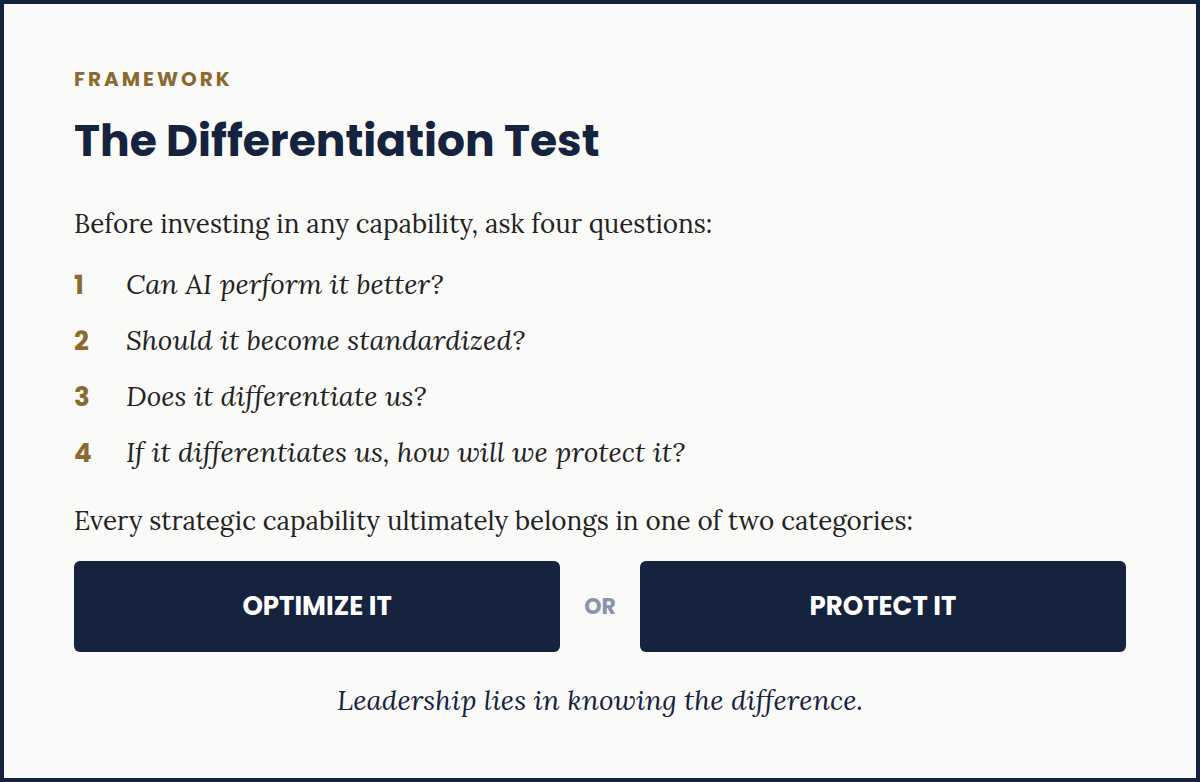
Don't ask whether AI will change your organization. Ask where AI changes the economics of differentiation. The test below is a simple place to begin.
The New Scarcity
Every technological revolution changes what organizations compete on. Great leaders recognize when value has migrated.
It does this by changing what becomes abundant. The Industrial Revolution made manufactured goods abundant, and craftsmanship became a premium. The Internet made information abundant, and attention became the scarce resource whole industries were built on capturing. Artificial intelligence is now making knowledge work itself abundant, the analysis, the draft, the code, the deck.
Whenever something becomes abundant, something else becomes scarce. Scarcity is where value migrates. For those who studied economics, you may recall the concept of scarcity of resources and its implications for supply and demand.
The scale of the shift underway is difficult to overstate. Global data-center capital expenditure is now expected to exceed $1 trillion in 2026 alone, driven by accelerating hyperscale AI deployments layered on already-substantial infrastructure spending. Goldman Sachs projects roughly $7.6 trillion in cumulative AI-related capital expenditure across compute, data centers, and power between 2026 and 2031. The five largest U.S. cloud providers alone are on pace to spend near $700 billion on AI infrastructure in 2026, nearly double the prior year, and governments are moving at comparable scale, from the European Union's roughly €200 billion AI Continent Action Plan to Gulf-state campuses measured in gigawatts rather than square footage.
This is capital moving toward a single conviction: that AI capability is becoming a baseline utility rather than a competitive edge in itself. The infrastructure buildout tells the same story the parking lot did. When every organization has access to comparable compute, comparable models, and comparable tools, the compute stops being the differentiator. It becomes the price of admission, like electricity, or a website.
History tells us that infrastructure rarely determines long-term winners. Railroads became infrastructure. Electricity became infrastructure. Cloud computing became infrastructure. The compute layer beneath today's AI systems is following a similar trajectory, though “AI” itself is a broader, less settled label than any of those three, a collection of capabilities rather than a single coherent utility. Executives who understand what's actually running underneath the label will make sharper decisions than those treating it as one thing. Infrastructure changes what becomes possible. Leadership determines what becomes valuable.
The energy numbers make this concrete in a different way. Electricity demand from AI-focused data centers surged roughly 50 percent in 2025 alone, and global electricity demand is now projected to grow at its fastest sustained pace in decades through 2030, with data centers a primary driver. That is an extraordinary amount of capital and physical infrastructure being deployed to build a capability that, once built, is available to nearly every competitor in nearly every industry at once.
Adoption data tells the rest of the story. McKinsey's 2025 State of AI survey, nearly 2,000 respondents across 105 countries, found that 88 percent of organizations now use AI in at least one business function, up from 78 percent the year before. Adoption, in other words, is no longer a differentiator; it is table stakes. Yet the same survey found only about a third of organizations have moved beyond pilots to scale AI across the enterprise, and just 6 percent report AI contributing more than 5 percent of EBIT.
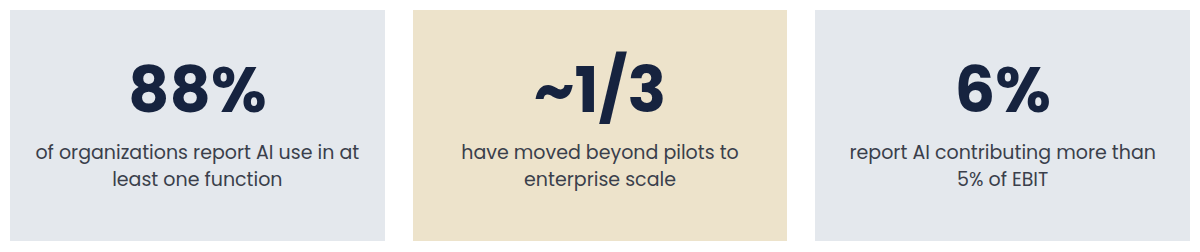
Access has become nearly universal. Value capture has not. That gap is the whole argument in miniature, and I see it in nearly every organization I work with: everyone gets the tool. Almost no one gets the outcome. What separates the two is not the model. It is judgment about where to apply it and, just as importantly, where not to.
As AI democratizes analysis, writing, coding, and content creation, organizations will compete less on access to these capabilities and more on judgment, trust, and the kind of thinking a model can't shortcut. This is the central proposition of this paper: in an age of abundant optimization, differentiation becomes the scarce resource that creates enduring value.
The Mathematics of Convergence
There is a useful analogy in statistics that conveys this well.
Picture a normal distribution, the familiar bell curve. Most organizations, most products, most resumes cluster near the mean, where the curve is tallest and most crowded. The tails, where the curve thins out, are where the outliers sit: the distinctly better, and occasionally the distinctly worse.
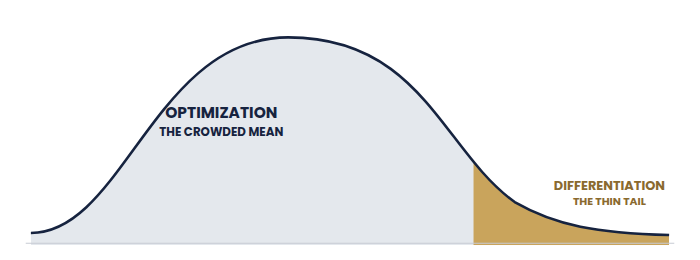
Optimization, by its nature, is a mean-seeking force. It studies what works across many cases and pulls outliers toward the average, because the average is, almost by definition, less risky and more reliably repeatable. Every best practice, once adopted broadly enough, does to an entire industry what a larger sample size does to a distribution: it narrows the variance. The curve grows taller and thinner. The distance between a good competitor and an average one shrinks.
AI is the most powerful mean-seeking force organizations have ever deployed: it learns from an enormous sample of what already exists and reflects the statistical center of that sample back at extraordinary speed. Applied everywhere, unchecked, it compresses the whole distribution, homes, websites, resumes, cars, toward the same narrow peak.
Differentiation, by contrast, is a deliberate move toward the tail. It is a choice to accept more variance, more risk, more cost, more difficulty to execute, in exchange for standing somewhere the curve is thin. That is precisely why it is hard to sustain, and precisely why it is valuable when it works. A strategy everyone can copy gets pulled back toward the mean the moment it succeeds. A strategy built on genuine originality, trust, or purpose resists that pull, because it cannot be reduced to a pattern a model can learn from everyone else doing it.
There's a further wrinkle worth naming. Organizations that optimize their routine activities create the capacity to invest disproportionately in the capabilities that truly distinguish them, efficiency, in other words, can fund differentiation. That may turn out to be one of AI's greatest strategic contributions.
The executive's task is not to resist the mean-seeking force altogether. Optimization earns its keep. The task is to decide, deliberately, which parts of the organization are allowed to be pulled toward the average, and which are protected, on purpose, at the tail.
Recognizing the Differences That Matter
Four examples make the principle concrete.
Executive Resumes — AI can make every résumé look executive. It cannot make every executive exceptional.
People hire for confidence, perspective, and judgment, not just experience. AI can improve structure, grammar, and presentation on almost any resume in seconds, and it does that job well. But line up a hundred AI-polished resumes and a hiring executive will notice the same problem I noticed in that parking lot: they read alike. The verbs converge; the achievements converge. I've done it too, polished a resume until it read like everyone else's. What AI cannot generate is a genuine answer to the one question a resume actually needs to answer: why you, specifically, for this? That depends on a candidate's own judgment about what mattered in their career, not a statistically likely description of what a strong career tends to look like.
Retail Banking — Technology became the price of admission. Trust, advice, and relationship became the differentiators.
A decade ago, mobile check deposit, real-time alerts, and peer-to-peer payments were genuine points of competitive distinction. Today, nearly every major bank's app offers a comparable set of features, built to a comparable standard, often on comparable underlying technology, and AI is accelerating every bank's ability to reach that baseline faster and more cheaply than the last. What customers actually choose a bank for now is something a feature list can't capture: whether they trust the institution during a financial emergency, whether a banker picks up the phone, whether the advice reflects their specific situation rather than a segment average. I've had this conversation with more than one banking leadership team, and it always lands the same way: nobody switches banks because of an app. They switch because someone let them down when it mattered.
Ferrari — Ferrari chooses this, deliberately, year after year.
Ferrari could, by most conventional measures of operational efficiency, build significantly more cars than it does. Demand consistently exceeds supply; the waiting list is itself part of the brand. A pure optimization mindset would treat that gap as a problem to solve, underused capacity, revenue left on the table. Ferrari treats it as the point, deliberately capping annual production and managing allocation to protect scarcity, even when the market would clearly absorb more volume at lower margin per car. It is a decision, made and remade every year, about which forms of variance the company will preserve, craftsmanship, exclusivity, identity, even when an optimization model would recommend eliminating them. Ferrari treats protecting differentiation as a deliberate economic strategy.
Professional Services — The future competitive advantage of advisory firms will not be their access to AI. It will be the quality of thinking they build on top of it.
Professional services illustrate the same principle. AI can produce methodologies. It can draft reports. It can summarize interviews. What clients continue to value is judgment, the ability to synthesize complexity, to challenge assumptions, to ask the question nobody else thought to ask.
In each case, AI improves the baseline. In none of them does AI supply the thing that actually separates the leader from the field.
The Cost of Convergence
Explaining why convergence happens is not the same as explaining what it costs. Neither is explaining why differentiation matters in the abstract. The harder, more relevant question is what an organization actually loses when it converges, and the answer is more specific than most executives assume.
The most immediate cost is pricing power. When customers cannot distinguish one offering from another, price becomes the only variable left to compete on, and margin follows the mean the way everything else does: down. A company that looks like its competitors gets treated like its competitors, including at the register.
Loyalty erodes for the same reason. There is no cost to switching between two things that are functionally identical, so customers do not switch reluctantly, they switch the moment a better price or a faster delivery window appears elsewhere. What looks like churn is often a company discovering, late, that it never gave anyone a reason to stay.
Innovation slows, counterintuitively, in the organizations racing hardest to keep up. A mean-seeking force rewards proximity to the average, not the wandering, occasionally wasteful experimentation that produces genuine breakthroughs. Organizations spending their attention matching best practice have, by definition, less attention left to build something no best practice yet describes.
Employer brand suffers the same way markets do. The best talent has options, and options are chosen on distinctiveness, the belief that this organization will ask something different of them than the one down the street would. An employer that has converged toward the industry average is left competing for talent on compensation alone, an expensive way to fight a war that better-differentiated competitors do not have to fight as hard.
The largest cost is the least visible: resilience, at the level of the industry rather than the process. There is a version of resilience that standardization genuinely builds, fewer errors, tighter controls, more predictable execution, and that version is real. But an industry in which every competitor has converged toward the same model, the same technology, the same customer experience, is a monoculture. It withstands ordinary conditions well and a single unexpected shock badly, because nobody in it occupies different ground. Strategic flexibility, the capacity to respond to a shift in preference, regulation, or technology in a way competitors cannot easily copy, depends on having built something different enough to retreat to. Organizations that have optimized away their differences have nowhere left to go.
There is also a governance implication. Boards increasingly oversee organizations whose operational capabilities are converging. Their attention therefore shifts from asking “Can management optimize?” to asking “What capabilities must remain distinctive if this organization is to create superior long-term value?” That is fundamentally a governance question.
“None of this shows up on this quarter's income statement.”
It shows up later, when an industry needs to change and discovers that everyone in it changed together, into the same thing, and has nothing left to become.
Leadership in the AI Era
Leadership has always required difficult choices about allocating scarce resources: capital, talent, attention. AI introduces a new resource to that list: machine intelligence, deployed at a scale and speed no previous generation of leaders had available to them.
As compute, infrastructure, and energy costs become increasingly transparent, visible in earnings calls, capital expenditure guidance, and electricity procurement contracts, the question leadership teams ask will shift, from “Can AI do this?”, which for most tasks will soon have an obvious yes, to “Where should AI create the greatest value, and where should we deliberately withhold it?”
Leadership teams will increasingly face a second allocation decision, not simply where to invest capital, but where to invest compute. Every AI interaction consumes infrastructure; every automated decision consumes computational resources. The organizations that answer this well will allocate both human and machine intelligence intentionally, asking in each case: where does additional compute create meaningful value, and where does human judgment create more?
The operating model of the next decade may well be built around that question: the intentional allocation of both human and machine intelligence, task by task, decision by decision. Routine analysis, first drafts, structured research, and repetitive execution will increasingly be automated, and organizations that resist that shift will simply be outcompeted on cost and speed by those that don't. We are already starting to experience this with the cost and utilization of tokens for various tasks.
But automating the routine does not shrink the list of things that matter. It shortens the list of things worth arguing about. What remains, and what becomes more valuable, not less, as the baseline rises around it, is:
Judgment. Curiosity. Context. Originality. Purpose.
None of those can be optimized into an organization from the outside. They have to be built, protected, and modeled by leadership, deliberately, the same way Ferrari protects scarcity and a strong bank protects trust: as a standing decision, revisited often, about what the organization will not allow itself to average out.
Those who have worked with me know I return repeatedly to two ideas: intentionality and purpose. Leadership has never been about making more decisions. It has always been about making the right decisions. Artificial intelligence doesn't change that responsibility. It makes it more visible.
Closing
Intentionality is often misunderstood as simply making deliberate decisions. I think it is something more demanding, it requires leaders to decide not only what to pursue, but what to protect. Not only what to automate, but what should remain human. Not only what to standardize, but what must remain distinctive. In an AI-enabled world, those choices become increasingly strategic.
Every technological revolution changes what organizations compete on. Great leaders recognize when value has migrated.
AI will raise the baseline. That much is already underway. On balance, that is a good thing, most organizations, most processes, most decisions will be measurably better for it.
A rising baseline, though, is table stakes rather than a strategy, the condition every competitor now operates under equally, which means it cannot be what sets any one of them apart.
As AI makes optimization available to everyone, what will remain impossible to imitate?
The organizations that create enduring value will be the ones that stay intentional about what makes them different. They will know precisely where they want the curve to pull them toward the mean. And precisely where they intend to stand at the tail, regardless of the cost.
The future won't belong to those who optimize the fastest. It will belong to those who remain intentionally different.
Technology should amplify human capability. It should never replace human purpose.
Optimization creates efficiency.
Differentiation creates value.
Intentionality determines the future.
Optimization may become universal.
Judgment never will.
The organizations that endure will not simply adopt artificial intelligence.
They will remain intentional about what they refuse to automate.
That is where enduring value will be created.
Sources referenced: McKinsey & Company, “The State of AI: Global Survey 2025”; Dell’Oro Group, Data Center IT Capex Quarterly Report (Q1 2026); Goldman Sachs, “Tracking Trillions: The Assumptions Shaping the Scale of the AI Build-Out” (2026); International Energy Agency, “Electricity 2026” and “Key Questions on Energy and AI.”