Executive Perspectives
Every technological revolution changes the economics of business.
AI is doing so at extraordinary speed, changing the cost of analysis, expertise, personalization, execution and scale, and beginning to challenge long-standing assumptions about how organizations deploy people, technology and capital.
In the first issue of this series, The Value of Differentiation™, I argued that as AI makes optimization increasingly abundant, differentiation, what a business deliberately chooses not to optimize away, becomes the scarce resource that creates enduring value. This piece asks the question that comes before that one: before deciding what to protect from optimization, leadership has to decide what business it is building in the first place.
The prevailing narrative is that AI will reshape business models, and leaders must prepare their organizations to respond.
I strongly believe that framing gives too much agency to the technology. That has been my philosophy from the start with technology, it enables, not drives.
AI should not define the business model. Leadership should. This is something I strongly believe- we have control of our destiny- not AI, and we have choices. This is not meant to be a philosophical article, but one grounded in the underlying principle of agency.
Leaders are responsible for determining the business they want to build, the customers they want to serve, the value they want to create, where they intend to differentiate and the economics they want that model to produce.
AI then becomes an extraordinarily powerful enabler.
A previously uneconomic service becomes viable. Personalization becomes possible at a scale that used to require an army of people. The relationship between scale and headcount stops being fixed, and an entirely different operating model comes within reach.
But those possibilities do not determine strategy.
Leadership does.
So perhaps the starting question should not be:
Where can we deploy AI?
It should be:
What business would we intentionally design if we were starting today?
Only once we answer that should we ask how human intelligence, machine intelligence and conventional technology should be deployed to build it.
That distinction matters, because efficiently allocating intelligence against yesterday's business model simply makes the wrong model more efficient.
The Changing Economics of Intelligence
An important body of thinking is already emerging around the economics of intelligence.
Citadel Securities' research group has examined how rapidly falling inference costs interact with the physical constraints underlying AI, compute, chips and power, in work such as "The Economics of Intelligence" and "Tokenomics." Nick Roseth, an AI transformation consultant, has been a prominent voice in that conversation, writing about how organizations decide which work should go to people, AI, or some combination.
These are important developments, and I would take the argument one step further. The strategic question is not simply how organizations allocate intelligence more efficiently. It is what business model leadership chooses to create as the economics of intelligence change.
Most operating models were built around assumptions inherited from the economics of the period in which they were created, and those assumptions were rational responses to real constraints, not arbitrary choices. Expertise was expensive because training it took years and losing it meant losing institutional memory, so organizations built hierarchies to protect and ration it. Analysis took time because gathering and synthesizing information was itself labor, so organizations built processes that assumed a delay between question and answer. Personalization cost more than standardization because tailoring anything to an individual required a person's attention, so organizations built products and services around segments rather than individuals. Scale required people because output scaled roughly linearly with headcount, so organizations measured growth in bodies. Capacity, as a result, was typically added in relatively fixed increments: another employee, another team, another location, another outsourcing arrangement. Sound familiar?
Every one of those constraints is a design assumption embedded in how a business is built, not a law of economics. AI begins to change several of them simultaneously, which means several of the load-bearing assumptions underneath a given operating model can give way at once, not just one at a time as previous technologies tended to do.
But changing economics do not tell management what to do with them. Each assumption can be relaxed in more than one direction, and the direction management chooses is a strategic decision, not a technical detail to hand to an IT roadmap.
Take a cheaper cost of analysis. Most finance teams will reflexively book that as a saving, straight to the expense line, and move on. Few will stop to ask whether the same drop in cost just made it possible to serve a customer segment that could never justify the economics before, which is a growth decision wearing a savings decision's clothes. The same split shows up in software development, where a lower cost of building can either trim the technology budget or open up markets that used to be too small to bother with, and in individual productivity, where a dramatic gain can shrink the organization to its old shape at a lower cost, or hold headcount steady and change what that headcount is actually for.
None of these are technology decisions. They preserve the existing business model, only cheaper to run, or they change what the model is. An organization that takes the first path without deliberately weighing the second has let the technology's economics choose its strategy by default.
The technology creates the economic possibility. Leadership determines the strategic response.
Business Model Before Technology
This distinction matters because much of today's AI activity begins one level too low in the organization.
Organizations identify use cases, launch copilots and agents, and ask functions to find activities that can be automated. All of that may be useful, but it starts with the existing enterprise.
A more fundamental question is:
If the economics underlying our business are changing, should the business itself change?
That is a design question, not a technology question. It takes the same rigor as any real exercise in critical thinking, naming the assumptions a business was built on, testing whether they still hold, and being willing to conclude that the business itself, not merely its processes, should look different.
Consider professional services, as an illustration rather than a prediction about any specific firm.
The traditional professional-services pyramid did not emerge accidentally, it reflected the economics of knowledge work. Large numbers of junior professionals performed research, analysis and production, billed at a modest multiple of their cost, while senior professionals provided interpretation, judgment and accountability, billed at a much higher multiple of theirs. That ratio was not a staffing preference, it was the profitability engine, and the entire structure of partnership, promotion and pricing was built to protect it.
AI potentially changes the economics of the work at the bottom and middle of that pyramid, the research, drafting and first-pass analysis junior staff are leveraged to perform. That is precisely why the obvious question, how many analyst hours can AI save, is the wrong one to start with. It treats the pyramid as fixed. But if the labor that justified the ratio becomes dramatically cheaper, the ratio itself stops being self-evidently correct, and the strategic question is whether the pyramid remains the right business model at all.
Fewer junior professionals is one answer, the automation answer, and for some firms the right one. Shrink the pyramid and keep its shape.
A more interesting answer starts from what clients actually pay for. If senior judgment is the real product, and the cost of supporting it with research and drafting falls sharply, that judgment can reach a far larger set of clients than the pyramid ever allowed, including engagements previously uneconomic to take on. Pricing can move from hours, which rewarded the labor now made cheap, toward outcomes, which reward the judgment it did not. That path does not require fewer senior professionals. It may require more, applied to a market the old cost structure could never reach.
Those are business-model choices about who the firm serves and how it prices judgment, not automation choices, and they cannot be delegated to the technology.
The "Move Faster" Objection
Before going further, it is worth confronting the objection this argument will draw: that business-model-first thinking sounds deliberate to the point of slow, while the market rewards speed. That deserves a direct answer, not a dismissal.
Speed and sequence are not the same thing. An organization can move quickly once it knows what it is building. What is slow, and expensive, is deploying AI broadly across an operating model built for different economics, then discovering the deployment made the wrong model faster rather than a better model possible. The fastest-moving AI adopters are rarely the ones with the most use cases live, they are the ones who spent the least time relitigating strategy after the fact, because they had already decided what the business was for. Business-first is not slower. It is sequenced.
When Lower Cost Creates a Different Customer Proposition
Banking provides a useful example.
Bank of America has disclosed that its virtual assistant, Erica, has now handled more than 3.2 billion client interactions, a scale of automated engagement that would have been uneconomic to deliver through human channels alone.
It would be easy to interpret figures like these primarily as an efficiency opportunity: reduce cost, improve the expense ratio, bank the savings. For a public bank managing quarterly expectations, that is also the path of least resistance, since a lower expense ratio is immediately legible to markets in a way a reinvested one is not.
But consider the alternative question:
What customer proposition does a material change in the economics of service now make possible?
A customer segment served almost entirely through digital channels could start receiving personalized financial guidance, closing a service gap that used to exist only for the affluent. A relationship manager could serve a broader population without diluting service, stretching a model that was always rationed by headcount. Underwriting and advice that once required a private-banking relationship could become available further down the customer base, and segments that only ever justified a cross-sell could become attractive to underwrite on their own terms.
These two paths are not compatible with the same headcount and branch footprint. Harvesting the savings leaves the bank looking much as it does today, only smaller. Reinvesting them means a different cost structure, a different mix of human and automated service, potentially a different customer base. A board weighing this is not reviewing a technology budget, it is deciding which bank the institution intends to be five years out, and the expense-ratio path will always look safer in this year's numbers even when it is the costlier choice.
That is why I am cautious about language suggesting AI will inevitably "transform" an industry.
AI changes possibilities. Leaders choose transformations, and the choice usually shows up first in what happens to the savings.
When the Unit of Value Changes
Software provides another example.
For decades, much of enterprise software has been monetized around human access: one employee, one seat, one license.
But what happens when software begins performing work rather than simply enabling a person to perform it?
Salesforce's Agentforce pricing is an instructive case. Its current model runs on consumption-based Flex Credits, priced per action rather than per person logged in, alongside legacy per-conversation and per-user options, and customers can convert user licenses into Flex Credits and back again. That last detail is the significant one, it treats human seats and machine actions as interchangeable units of the same budget, not two different products, which is more significant than a pricing adjustment.
If an AI agent completes work that previously required several people interacting with software, the economics of a seat-based model begin to change. A customer who needs fewer people needs fewer seats eventually, whatever the pricing page says, and a vendor that does not reprice around the new unit of value is not protecting its revenue, it is waiting for the customer to notice the mismatch first.
Nor is this unique to Salesforce. Every category monetized around human access, ERP, HR systems, service-desk tools, faces the same reckoning as agents start doing work a seat used to merely enable, and incumbents have a real incentive to move slowly, since a consumption model can cannibalize seat revenue before it replaces it with something larger. That tension is a strategic choice, not a pricing detail for finance to settle alone.
The strategic question for a software company therefore is not simply how to add AI to its product. It may need to ask:
What exactly are customers paying us for in an AI-enabled world, access, usage, capacity, or the work itself getting done?
Once again, AI does not provide the answer, it changes the economics enough that leadership must reconsider the question. A company that answers honestly, even at some short-term cost, is making a different bet than one that answers defensively.
The Hidden Economics of AI
There is another reason leaders need to approach these decisions deliberately: AI itself is not free, and increasingly its economics are not simple. Consider something deliberately mundane, drafting an email- one of my guilty pleasures.
Assume an employee earns $100,000 a year. At first glance, using AI to draft an email appears economically obvious, a few moments of machine time replacing several minutes of human labor.
But the comparison is incomplete. The employee already understands the history, the recipient, the sensitivities, the context, and may compose the response in minutes. For an AI system to reach the same result, it may need to retrieve the email chain, ingest prior correspondence, access documents, maintain context, reason across it, call other systems, generate a response and perhaps regenerate it before a person reviews and approves it. The visible output may run a few hundred words. The underlying computation can be considerably larger, and as organizations move from prompts toward agents, that gap matters more: cost depends on context, model choice, reasoning, tool calls, caching and how many loops the agent runs.
The gap is not just large, it is unpredictable. McKinsey's own research on agentic systems has found that an identical task can vary in token cost by up to thirty times from one run to the next, depending on how the agent reasons its way there. A cost estimate built on a single test run is a guess with more decimal places, not an estimate.
A Wall Street Journal analysis this month found the same pattern holds at the model level, not just the task level: the lower-priced model ended up costing more than the higher-priced one on roughly a third of over 6,800 tasks tested, because the cheaper model needed more retries, longer outputs or more attempts to finish the job. Sticker price and the actual cost of getting the work done are not the same number.
This is why managing cost per successful outcome, rather than cost per token, is the more useful discipline, and McKinsey researchers made close to the same point this month: what an initiative spent is a different question from whether it should have spent it, and an agent is worth deploying only when its odds of succeeding beat the ratio of verification time to task time. A more formal version of the same question this piece keeps returning to.
But I would not make cost optimization the strategic objective.
The more important question is:
Was machine intelligence the right resource to deploy against this outcome in the first place?
Sometimes the answer is clearly yes. Just as often, conventional software turns out to be cheaper, a person turns out to be more effective, or the best economics come from combining the two. Asked activity by activity, rather than once at the enterprise level, that question is the beginning of a discipline rather than a slogan, and it is the question the allocation framework later in this piece is built to answer systematically.
When Consumption Becomes Visible
AI adoption has often been encouraged without the same cost transparency applied to other enterprise resources. That is beginning to change.
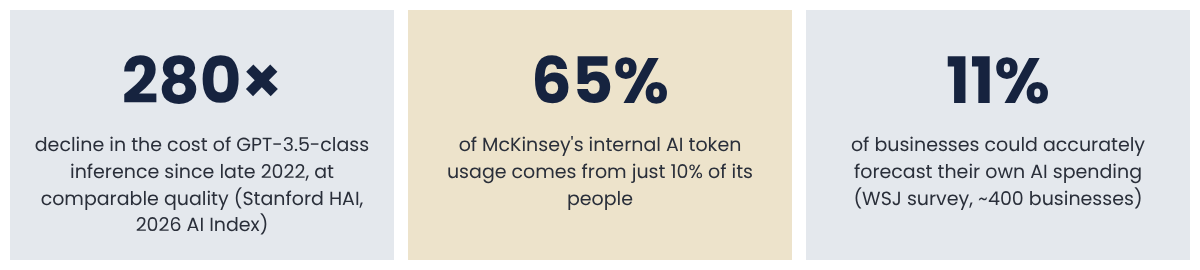
Debasish Patnaik, who leads McKinsey's QuantumBlack AI practice in the UK, has disclosed that the firm processes roughly five trillion AI tokens a month internally, and that consumption is highly concentrated: about 10 percent of users account for roughly 65 percent of usage, consultants and engineers heaviest among them. Rather than imposing hard caps, McKinsey tracks consumption per person and flags excessive use, treating it, in Patnaik's words, like mobile data on a work phone.
When consumption becomes visible, allocation becomes a management decision.
Organizations can begin asking:
Does this task actually require the most sophisticated model available, or would a cheaper one do the job just as well? How much context does the agent really need, and how much human review still has to sit on top of it? At some point the honest answer to whether an activity warrants more machine intelligence at all is no, and that answer should be allowed to surface.
High consumption does not necessarily mean high value, any more than a business would celebrate a department for consuming the most capital. That same concentration cuts both ways: most of the organization's AI value, and most of its waste, likely sits with the same small number of people and decisions, rather than spread evenly across the enterprise.
Governing AI spend as a flat, enterprise-wide adoption metric, more users, more licenses, more copilots activated, is governing the wrong variable when spending behaves this way almost everywhere it has been measured. The more useful unit of attention is the top decile of usage, what those heaviest users are doing with it and whether the pattern deserves to spread or to be reined in. Treating AI governance as concentrated capital allocation, rather than an even rollout, is itself a choice about how the resource gets managed.
The Paradox of Cheaper Intelligence
There is an apparent contradiction at the center of AI economics. AI is becoming dramatically cheaper to use, yet enterprise AI expenditure may still rise substantially. Both can be true.
Stanford's 2026 AI Index found that the cost of inference for GPT-3.5-class model performance fell roughly 280-fold in the two and a half years since ChatGPT's launch, a decline at comparable quality rather than a trade-down to a cheaper, weaker model.
Economists have a name for this, the Jevons paradox, after the nineteenth-century observation that more efficient coal-fired engines led to more coal consumption overall, not less, because efficiency made new uses of coal worth pursuing for the first time. The same logic applies here: employees move from short prompts to research, document analysis and coding, applications retain longer context, agents invoke tools and reason iteratively across systems, and machine intelligence becomes cheaper per unit while becoming more material in aggregate.
That matters because organizations have historically added knowledge capacity in visible increments, another analyst, another lawyer, another consultant. Machine intelligence gets added dynamically instead, more inference, a larger model, longer context, more agents, more tasks, which makes its economics increasingly visible and increasingly variable at the same time.
Leaders are living that variability in real time. A Wall Street Journal survey this month found that only 11 percent of roughly 400 businesses could accurately forecast their own AI spending, which says something about this cost line that finance has not fully absorbed yet: it does not behave like the cost lines it sits next to on the income statement.
But the objective still should not be optimizing consumption independently of strategy. We first need to know what we are trying to build.
Intelligence Is Still Physical
AI can feel almost infinitely scalable, a question disappears into a screen and an answer returns seconds later. But machine intelligence is supported by a physical supply chain: models, chips, servers, data centers, grid capacity, energy.
The International Energy Agency projects that data-center electricity consumption will more than double from roughly 415 terawatt-hours in 2024 to around 945 terawatt-hours by 2030, a level of consumption slightly higher than Japan's total electricity use today, with AI as the primary driver and the United States accounting for the largest share of the increase. At the same time, the industry faces constraints involving grid connections, electricity generation, semiconductor capacity and other infrastructure.
A simple text interaction is not economically equivalent to extended reasoning or an agentic workflow, and the resource requirement can differ dramatically between them. Digital intelligence can scale at software speed, but the physical infrastructure underneath it cannot, and falling unit costs should not be confused with economically infinite intelligence. Machine intelligence has a capital stack, same as any other physical resource.
Scarcity has not disappeared, it has moved, from the cost of a query today to the availability and price of compute over the life of whatever gets built around it. Organizations that lock in compute access are making a different bet than those relying on the spot market to always be cheap. That is a capital-allocation decision for the board, not a procurement detail.
The Allocation Test
Once leadership has determined the business model it wants to build, the resource-allocation question becomes much more useful, and it deserves a sharper tool than instinct.
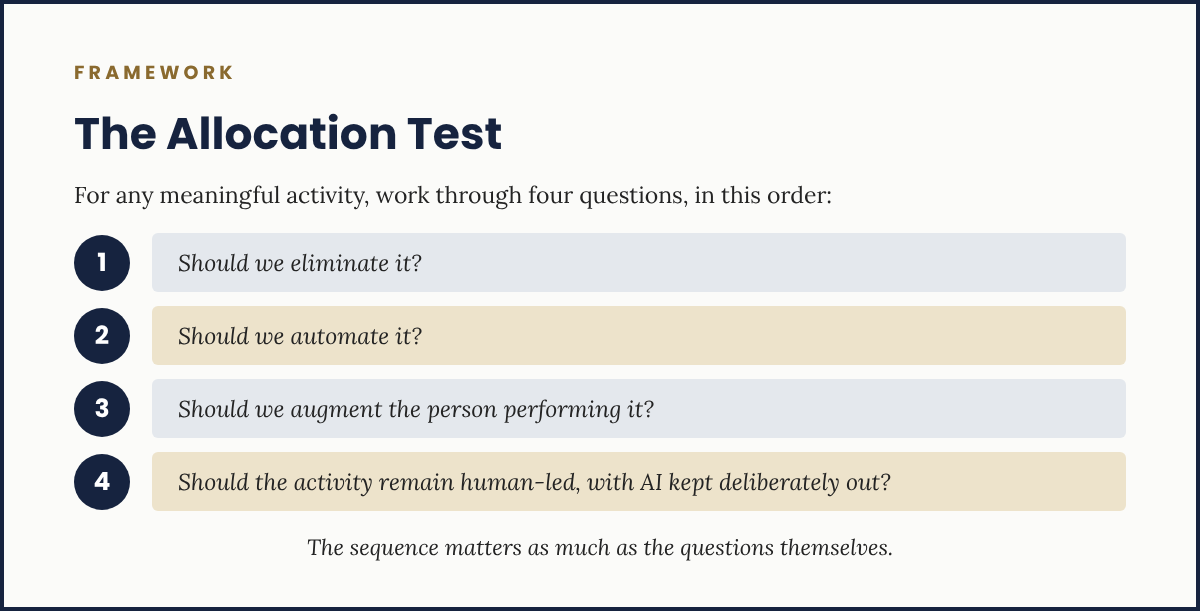
Efficiency applied to unnecessary work is still waste, only faster. Before deciding whether a person or a machine should perform an activity, ask whether it should exist at all. One of the least attractive outcomes of the AI era would be deploying enormous compute to automate processes that should have been removed.
AUTOMATE
A rules engine or conventional software may be cheaper and more reliable than a model for a genuinely repeatable task.
Where the outcome is repeatable and measurable, automation may be the obvious choice, and that technology does not necessarily need to be AI.
AUGMENT
This is usually where the richest economics sit, and where most organizations underinvest relative to pure automation.
For many knowledge-intensive activities, the highest return comes from combining machine scale and speed with human judgment and accountability.
HUMAN-LED
Applying AI simply because it is available can destroy value here rather than create it.
Some activities derive their value precisely from human judgment, trust, originality or accountability.
These are not permanent categories. As capabilities, costs and business models evolve, an activity can move from human-led to augmented to automated over time. But the test should be applied in this order, every time, because skipping straight to "automate or augment" without first asking "should this exist" or "should a person alone own this" is how organizations end up efficiently executing the wrong model.
Applied to an actual activity, the sequence produces a different answer than instinct would. Take loan-documentation review at a commercial bank, usually handed straight to the automation question because it looks repeatable. Run it through the test in order instead. Eliminate: some of the documentation being reviewed exists only to satisfy a process that has outlived its purpose, so the first yield is less volume before a dollar is spent on technology. Automate: extracting defined data points against defined rules, dates, parties, covenant thresholds, is genuinely repeatable, and a well-scoped automation may outperform a large model on cost and reliability for exactly this slice. Augment: the judgment calls, an ambiguous covenant, a structure that does not match the template, are where a person working with AI-assisted synthesis is faster and more accurate than either working alone, usually the largest remaining pool of value. Human-led: final sign-off on exceptions carrying real credit or legal risk stays with a named individual whose judgment and accountability the bank is actually relying on, because the value of that step is the accountability itself. The output is not one answer, it is four different answers for four slices of what looked, at the outset, like a single task, and that decomposition is the actual discipline.
From AI-First to Business-First
This is where I would challenge one of the dominant narratives surrounding AI.
AI-first is not a business strategy. Many may disagree, and that is fine.
A business can deploy enormous amounts of AI and still have the wrong product, the wrong customer proposition, the wrong operating model or no meaningful differentiation. Technology can make that organization faster. It can make it cheaper. It can make it more automated. But it cannot determine what the organization should become.
The vocabulary here is shifting quickly. A cluster of recent arguments, some calling for "AI-native" organizations, others urging companies to design themselves for AI rather than retrofit AI onto what they already are, are converging on the same instinct: redesign the business around intelligence as the operating principle, not merely adopt AI tools inside an existing structure. That is progress, in that it moves past treating AI as a bolt-on, but it still starts in the same place the AI-first narrative always starts, with the technology as the organizing idea. Redesigning around AI is still a decision about what to redesign around, and that decision belongs to leadership. The organizing idea should be the business leadership wants to build. AI, native or otherwise, is how it gets built.
A different response, to a genuinely different question, appeared recently in Harvard Business Review, arguing that AI can widen the option set available to corporate strategists and free human judgment from routine analysis. That is a real contribution, but it improves the process by which leaders arrive at strategy. This piece is about the decision that comes before that process starts, what the leader is trying to build in the first place, before AI enters the room as either a tool or an organizing principle.
That remains leadership's responsibility.
The strategic sequence therefore matters:

That is fundamentally different from beginning with a list of AI use cases.
The Leadership Question
Every technological revolution changes what organizations compete on. Great leaders recognize when value has migrated.
AI is changing the economics of expertise, analysis, personalization, execution and scale. It is giving organizations access to productive capacity that previous generations of leaders could not have imagined.
But access to that capacity does not eliminate the need for judgment. It increases it.
The winners will not necessarily be the organizations employing the fewest people, consuming the most AI, or running the greatest number of agents.
They will be the organizations that understand what they are trying to become and deliberately deploy their resources to get there.
That requires leaders to resist allowing the technology itself to become the strategy.
The first question is therefore not:
Where can we use AI?
Nor even:
Where should we allocate intelligence?
It is:
What business would we intentionally design if we were starting today?
That is what it means to exercise agency here, not asserting it as a principle, but applying it as a discipline: design, tested and revisited, activity by activity.
Then we can ask what changing economics make possible. What should remain scarce. Where differentiation matters. Where human judgment creates value. Where machine intelligence changes the equation. And where neither should be deployed at all.
Because ultimately, AI changes what is economically possible. Leadership decides what becomes economically valuable.
QUOTE BLOCK: select the five lines below and format them as a Quote block (or leave as plain paragraphs). Quote blocks hold plain text only.
AI changes what is economically possible.
Leadership decides what becomes economically valuable.
The organizations that endure will not be the ones that deployed the most AI.
They will be the ones that knew, with precision, the business they were building,
and deployed every resource, human and machine, on purpose.
Sources & References
Sources referenced: Citadel Securities, "The Economics of Intelligence" and "Tokenomics"; Nick Roseth, writing on allocating work between people and AI; Stanford HAI, 2026 AI Index; International Energy Agency, "Energy and AI"; Bank of America, disclosed Erica usage data; McKinsey & Company / QuantumBlack (Debasish Patnaik), internal AI token consumption data; Salesforce, Agentforce pricing documentation; McKinsey Quarterly, "The Cost of Intelligence" and "Cost versus Value: Managing Agentic AI System Performance" (September 2026); The Wall Street Journal, AI token-spending analysis (2026).
Note: the professional-services pyramid discussion is illustrative strategic reasoning, not a reported case study of any specific firm.