Scope creep. Changing requirements. Misaligned expectations. Resource constraints. Budget overruns. Delayed implementations. And perhaps most frustratingly, the realization that what was delivered was not necessarily what the business needed.
I have seen change from many vantage points: in audit and finance, in operations, in risk and enterprise resilience across global financial institutions, and now in the boardroom and as an advisor. The view from the boardroom has been the most revealing, because it is where the gap between what was planned and what was achieved finally has to be explained. I have often reflected on how much our approaches to delivering change have evolved, and how familiar the underlying challenges remain.
We have moved from detailed requirements and sequential implementation programs to agile methodologies, iterative development, digital platforms, and now increasingly intelligent and autonomous technologies. Yet the conversations remain remarkably familiar, and so do the frustrations.
Looking back, I wonder whether we sometimes became so focused on managing the mechanics of delivery that we lost sight of a more fundamental question.
What were we actually trying to achieve?
In my experience, the intended business outcomes were frequently less clearly defined or understood than the budgets, timelines, and resources allocated to deliver them. AI raises the stakes. When building becomes faster and cheaper, the constraint shifts from delivering solutions to deciding which ones are worth delivering. And as AI systems begin to act with increasing autonomy, leaders will need to give direction to the systems their teams deploy, as well as to the teams themselves.
How much direction should leadership provide to ensure the right outcomes without constraining the creativity, experimentation, and discovery required to achieve them?
Too much direction risks prescribing solutions before the problem is fully understood. Too little risks teams building capabilities that are technically impressive but disconnected from the organization's strategic priorities.
This is the paradox of intentional leadership. My answer is that leaders should be fixed on the outcome, firm on the boundaries, and free on the solution. How much more they prescribe should depend on two things: how well the solution is understood, and how severe the consequences of getting it wrong would be. Clarity about the outcome is what gives teams the confidence to experiment, and it is what keeps increasingly autonomous AI working toward the right ends.
When Delivery Becomes the Destination
Most of us who have led change, myself included, have at times been clearer on the plan than on the purpose. I have seen what that costs. One program had been underway for two years. Its original purpose was to provide transparency into the costs being incurred across the organization by mapping the dependencies that drove them. By the time it completed, many stakeholders were unclear about what was actually being delivered. The program declared victory because it had finished. But no one could say clearly what it was for, or what it could now be used for, and the benefit realized was minimal.
The lesson I took from it was simple. Without clarity of intent, there was nothing to guide the work along the way, and nothing against which to judge whether it had succeeded at the end.
The pattern is common. In a 2021 McKinsey survey of more than 1,000 executives, respondents whose transformations were considered successful estimated they had captured only 67 percent of the potential financial benefits. At other companies, the figure was 37 percent. In 2024, the Project Management Institute went as far as redefining project success as delivering "value that justifies the effort and expense," a broader test than scope, schedule, and budget alone.
The cause usually lies in what gets measured. When outcomes are poorly defined, teams gravitate toward the measures by which they are evaluated. If success is measured through delivery dates, teams prioritize delivery dates. Agile changed this less than it promised. Many organizations came to treat its mechanics (releases, velocity, backlog completion) as evidence of its outcomes, becoming more agile in how they build while remaining rigid in how they think.
The result is an accountability gap. The program team delivers the platform, technology keeps it running, the business is expected to realize the benefits, and finance tracks the spend. But who is accountable when the platform works as designed and the anticipated outcomes do not materialize?
For a board, this is the gap that matters most. Approving the investment is the easy part. The harder part is knowing who will answer for the outcome once the program team has moved on.
“We have become very good at measuring delivery, but not always at measuring outcomes.”
Strategic Intent and Strategic Prescription
In the second issue of this series, Business-First Design, I argued that organizations must shape their business models intentionally, so that technology adoption does not determine their future by default. That raises an obvious question. If leadership must be intentional about the future business model, how much of it should it define in advance?
The answer begins with a distinction between strategic intent and strategic prescription. Strategic intent establishes what an organization is trying to achieve and why it matters. Strategic prescription determines how that ambition should be realized. The two are related, and leaders often confuse them.
The distinction is far older than agile. The military doctrine of mission command, which traces back to the nineteenth-century Prussian army, gives subordinates a clear statement of the commander's intent and the constraints that apply, then leaves them free to decide how to achieve it as circumstances change. Netflix has built a similar principle into its culture, describing it as leading with "context, not control." In both cases, clarity of intent is what makes initiative safe. People take reasonable risks when they know what they are aiming for and where the lines are.
Intel shows what this can produce. In the early 1980s, Intel still thought of itself as a memory company. But a resource-allocation rule that directed scarce manufacturing capacity toward the products earning the highest margins steadily shifted production toward microprocessors. Stanford professor Robert Burgelman's research showed that this shift had largely taken place through the decisions of middle managers before top management formally changed the corporate strategy and exited memory in 1985. The strategy emerged from below, but within a boundary leadership had set, and it still required leadership to recognize what was happening and commit the company to it.
The same logic now applies to machines. An AI agent that can plan and act on its own is, in effect, receiving delegated authority. Like a team, it needs a clear objective, explicit limits on what it may and may not do, and a named person accountable for what it does. Specifying every step defeats the purpose of using it. Leaving it without boundaries invites risk. Researchers at Google DeepMind have reached a similar conclusion, arguing that how closely an AI agent is overseen should depend on how critical, uncertain, and reversible its task is. Regulators are moving in the same direction: the EU AI Act requires high-risk AI systems to be designed so that people can oversee them effectively. The paradox of intentional leadership is beginning to apply to software as well as to people.
Not every initiative can be run this way. A financial institution implementing a critical payments capability cannot allow teams to discover their own definitions of settlement integrity or customer protection. The real question is what should be fixed and what should remain free, and the answer depends on the situation. Leadership remains accountable for the questions being asked, the boundaries established, and the value being pursued, even when it leaves the answers to others.
The Direction Grid
Three things should be fixed in every case: the outcome, the boundaries, and the accountable owner. How much more leadership prescribes should depend on two questions. How well is the solution understood? And how severe would the consequences of getting it wrong be?
The Direction Grid draws on two established ideas. Dave Snowden's Cynefin framework sorts problems by how well they are understood, and the DeepMind research ties oversight to how critical and uncertain a task is. The grid brings them together into one test of how much leaders should prescribe, applied to people and AI alike.
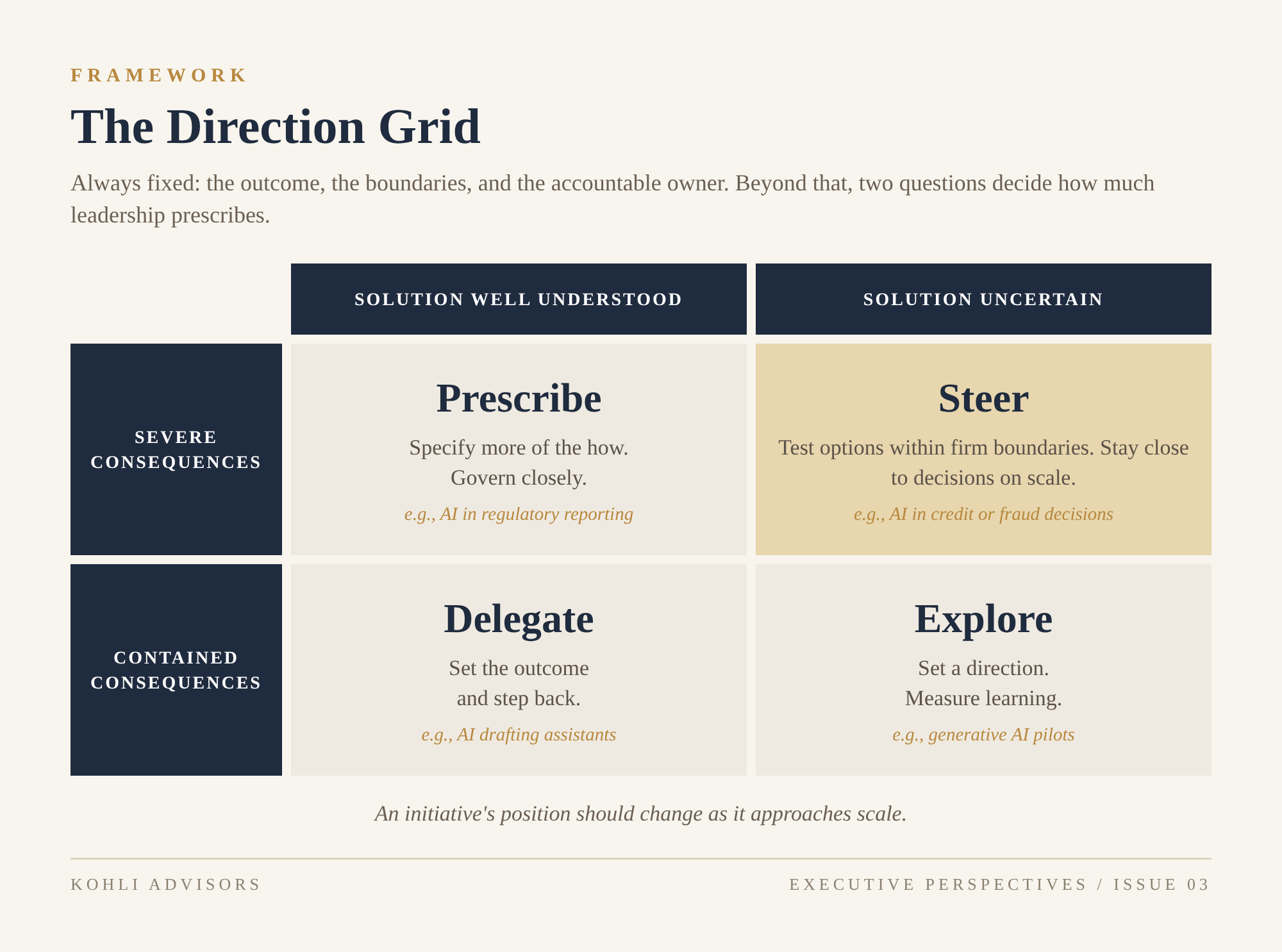
Delegate. Where the solution is well understood and the consequences of error are contained, leadership sets the outcome and steps back. Rolling out an AI assistant for drafting and summarizing is a typical example, and governing it heavily wastes the organization's capacity.
Prescribe. Where the solution is well understood but failure would be severe, leadership specifies more of the how and governs closely, because the cost of improvisation is too high. AI that touches regulatory reporting, or that falls under model risk management requirements, belongs here.
Explore. Where the solution is uncertain but the downside is contained, the outcome is expressed as a direction, and success is measured by what is learned. Most early generative AI pilots should sit here.
Steer. Where the solution is uncertain and the consequences are severe, teams develop and test options within firm boundaries, and leadership stays close to the decisions about which option to pursue and when to scale. Using AI in credit or fraud decisions is a clear example.
An initiative's position on the grid should change over time. An idea that starts in Explore should move toward Steer or Prescribe as it approaches scale and its consequences grow, and the direction it receives should tighten with it. The same two questions should decide how much an AI system may decide on its own, and when a person must decide instead. Most governance models fix the level of oversight when an initiative is approved and leave it there. A pilot that has grown into something the business depends on needs different direction from the one it was given on the day it was approved.
I have also seen the grid work well. One program was driven directly from the strategy. Leadership was clear about the intent and the issues it was solving for, but did not prescribe the solution. The development teams were free to propose different approaches, including whether to go live in a single big-bang implementation or to phase the rollout by business or region. The program finished on time and on budget.
In another case, an M&A integration for part of an organization involved merging functions across the businesses to realize synergies, align the operating model, and choose which platform would survive. Central to the work was consolidating financial and regulatory reporting. The right oversight and governance were in place from the start, and there was clarity about what was being solved for. That meant understanding where the businesses had requirements in common and knowing where the genuine exceptions lay. It finished ahead of schedule, with no post-implementation issues.
On the grid, the first sat in Steer and the second in Prescribe. In both cases, clarity of intent was what made the speed possible. Experiencing both failure and success, and observing others do the same, has convinced me how important it is to have an outcome-led approach in how we think, build and transform.
The grid also protects experimentation. A clear outcome should never become a demand for a business case before anyone is allowed to try anything. In the Explore quadrant, insisting on precise targets in advance will kill the very discoveries leadership hopes for.
AI and the Economics of Discovery
AI changes the economics of discovery. As AI-assisted development, configurable platforms, and accessible technology services reduce the cost and time of building new capabilities, organizations can explore more possibilities than ever before. That is an opportunity leaders should embrace.
But lowering the cost of experimentation does not lower the cost of changing an enterprise. A prototype may be inexpensive to build but costly to integrate, secure, control, and support at scale. A 2024 BCG survey of 1,000 senior executives found that only 26 percent of companies had built the capabilities to move beyond proofs of concept and generate tangible value. BCG estimated that about 70 percent of the challenges in AI implementation relate to people and processes, and only 10 percent to the algorithms themselves. A 2025 study from MIT's NANDA initiative reported that the large majority of enterprise generative AI pilots had produced no measurable impact on profit and loss, and attributed the gap mainly to how poorly the tools were integrated into the way work actually gets done.
Both findings point to the same need: a better path from experiment to enterprise. When several business units independently build AI solutions to similar problems, each may look successful on its own while the enterprise accumulates duplicated technologies, inconsistent data, fragmented controls, and no way to scale the best solution. Organizations that demand a fully quantified return before any experiment begins fail in the opposite direction, rejecting the very opportunities most capable of creating new value.
“AI can accelerate the creation of solutions. Deciding which problems are worth solving remains the work of leadership.”
The gate that matters most sits between experiment and scale. That is where an initiative's position on the grid should change, and where leadership must decide whether to continue, scale, redirect, or stop. Stopping is the hardest of these decisions, and the one most often avoided. An experiment that has disproved its premise, or a program whose goals can no longer be met at an acceptable cost, should be stopped deliberately, before it drifts.
Getting these decisions right depends on the right kind of friction. Some friction is valuable. When a technology team challenges a business requirement, or a risk function questions how an AI model will be used, the disagreement may expose an untested assumption, or a step that should be eliminated before anyone automates it. The problem arises when teams do not understand the intended outcome, so the argument centers on the requirement and loses sight of the result. With AI, decisions can be carried out at machine speed, which makes the challenge that comes before them more valuable. Business, technology, and risk reach better answers together than any of them does alone. The leadership challenge is to remove what obstructs progress while preserving what improves outcomes.
The competitive advantage will belong to those most effective at converting discovery into sustainable enterprise value.
From Intent to Action: The Intent Brief
Clarity of intent is easy to endorse and hard to practice. One simple discipline helps. Before any significant investment is approved or experiment begins, leadership should be able to answer five questions on a single page.
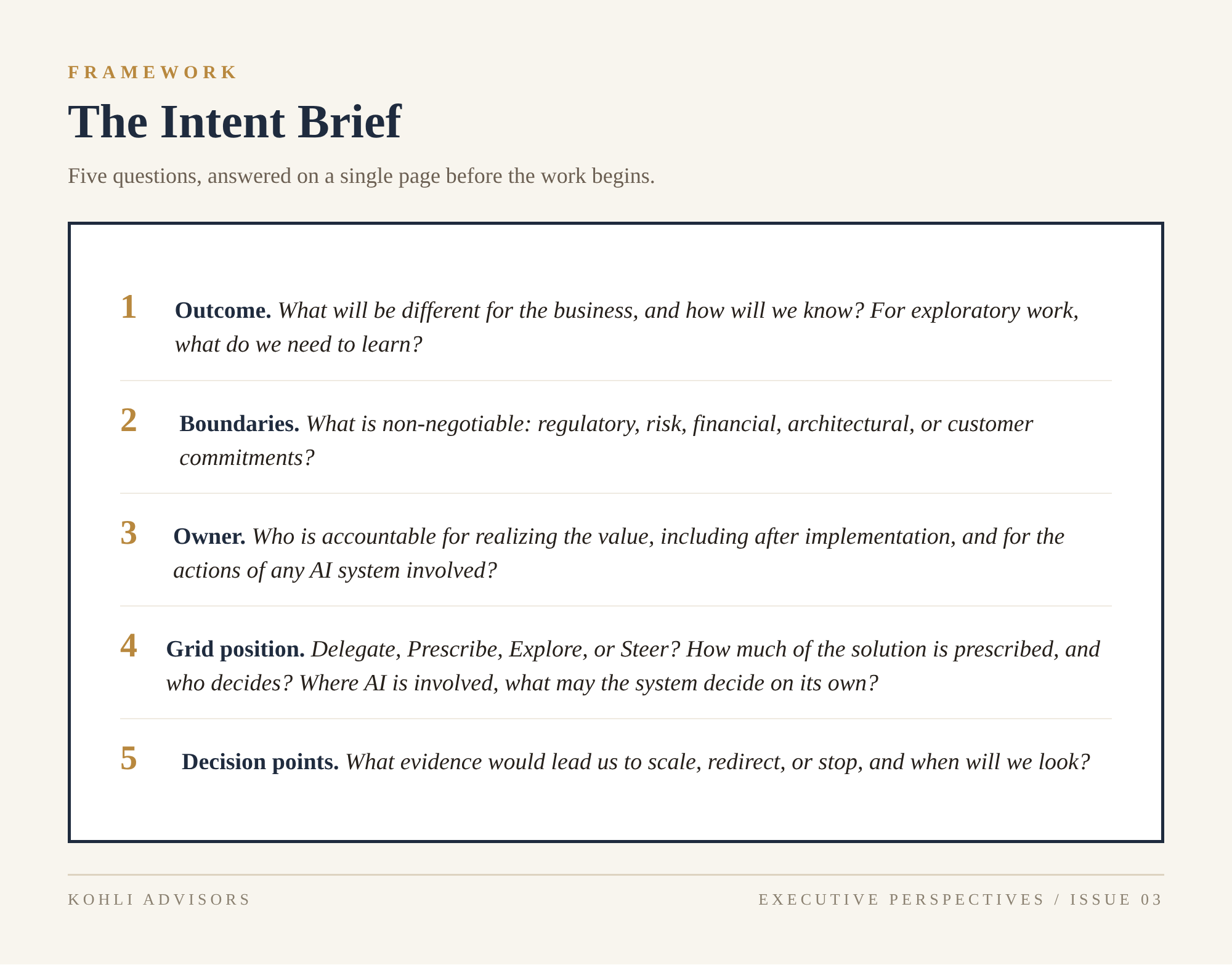
The brief is deliberately short. It takes far less effort than a business case and should never delay the start of work. Its purpose is to make the intent explicit enough that teams can act on it, and that leadership can later judge whether it was achieved. Had the program I described earlier been required to complete one, the missing answer to the first question would have been visible on the first day, two years sooner.
The brief also changes how progress is reviewed. An executive dashboard that shows a program on schedule and within budget should also show whether the solution is being adopted and whether the expected benefits are materializing. For experiments, the questions that matter are what has been learned and what decisions it has informed; the number of pilots launched says little. A team that stops an experiment because it disproved a promising idea has done its job.
Three Questions for the Board
For boards, the brief reduces to three questions worth asking of any significant investment.
First, what business outcome justifies the investment? Beyond the capability delivered, what measurable difference is it expected to make?
Second, what are we learning that might change our original assumptions? Strategic intent must be accompanied by a willingness to adapt.
Third, who remains accountable for realizing value after implementation is complete? This closes the gap between delivery and sustained performance.
“Accountability should follow the outcome well beyond the delivery milestone.”
How Much Direction Is Enough?
The paradox of intentional leadership has persisted through decades of re-engineering, technology implementation, and organizational change. We have changed our methodologies, accelerated delivery, and expanded what organizations can build. AI is the latest, and most demanding, test of the same challenge.
So how much direction is enough? Enough to make the outcome unmistakable, the boundaries explicit, and the accountability clear. Beyond that, as much as the uncertainty of the solution and the cost of failure demand, and no more. The rest belongs to the people closest to the work and, within clear limits, to the AI systems they deploy.
The paradox starts long before the boardroom. Many of us learned in classrooms where answers were prescribed and the reward went to recalling them, and those habits travel into how we lead. Leaders who were taught to follow instructions often default to giving them. AI could deepen the pattern. If people hand their research and reasoning to a tool, they may lose the very capacity to connect the dots that being free on the solution depends on. Intentional leadership carries a second responsibility as a result: building the judgment in people that makes it safe to leave the answers to them.
AI makes this question more pressing. When the cost of building falls and systems can act on their own, the scarce resource becomes clarity about what is worth delivering, and the judgment to direct both people and machines toward it.
Boards rarely see the work itself. What they can insist on is clarity about what the investment is for, who answers for the outcome, and when it will be judged. Insisting on those three things does more to protect value than any review of milestones. The real measure of intentional leadership is how effectively an organization turns discovery into meaningful business outcomes, even when that means departing from its original plan.
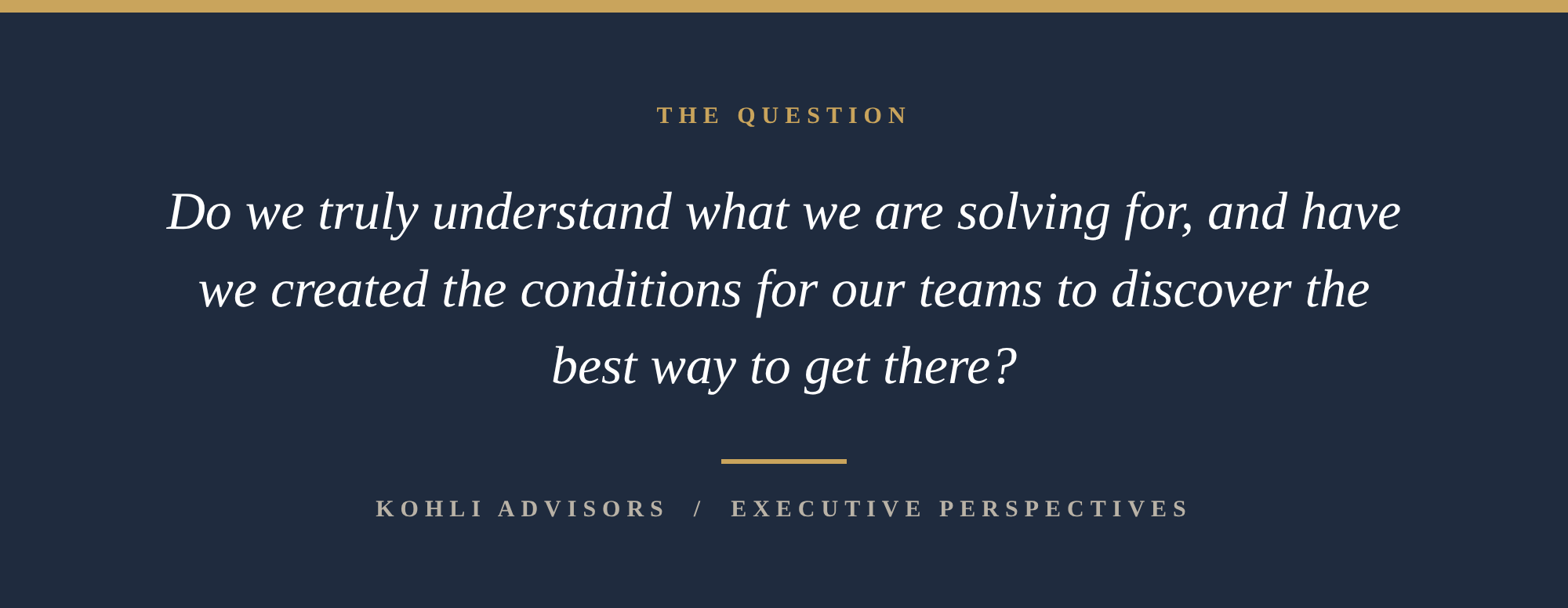
And that brings us back to a question that should precede every significant investment, AI deployment, or strategic initiative:
Read the earlier issues in the series: Issue 01, The Value of Differentiation™, and Issue 02, Business-First Design.
Acknowledgment
This issue was prompted by a question from Wilson White about how much direction leaders should give, a tension we often see. My thanks to him, and to everyone who shared their views and challenged my thinking along the way.
Sources & References
Sources referenced: McKinsey & Company, "Losing from day one: Why even successful transformations fall short" (December 2021); Project Management Institute, project success research and framework (September 2024); Stephen Bungay, The Art of Action: How Leaders Close the Gaps between Plans, Actions and Results (2011); Reed Hastings and Erin Meyer, No Rules Rules: Netflix and the Culture of Reinvention (2020); Robert A. Burgelman, "Fading Memories: A Process Theory of Strategic Business Exit in Dynamic Environments," Administrative Science Quarterly (1994); Nenad Tomašev, Matija Franklin and Simon Osindero, Google DeepMind, "Intelligent AI Delegation" (February 2026); European Union, Artificial Intelligence Act, Regulation (EU) 2024/1689, Article 14, "Human oversight"; David J. Snowden and Mary E. Boone, "A Leader's Framework for Decision Making," Harvard Business Review (November 2007); Boston Consulting Group, "AI Adoption in 2024: 74% of Companies Struggle to Achieve and Scale Value" (October 2024); MIT NANDA, "The GenAI Divide: State of AI in Business 2025," as reported by Fortune (August 2025).
Note: the program and integration examples are anonymized observations, not reported case studies of any specific organization.